

The power of a State is no longer measured solely by its territory or its industry, but by its technological and cognitive sovereignty. In an economy driven by AI and quantum computing, the vital resource is the intellectual capacity of the youth to design complex architectures. However, a major geopolitical fracture currently opposes two models: Chinese neuro-protectionism and European cognitive decline.
1. Cognitive Preservation: The Chinese Model
Beijing considers its youth’s attention as a national strategic resource. Facing algorithmic attrition, China has deployed a strict coercive arsenal:
- Video game limitation: Since 2021, minors are limited to 3 hours of gaming per week (only from 8 PM to 9 PM on weekends). Tencent’s AI and facial recognition prevent any circumvention.
- Internet rationing: Strict digital curfew from 10 PM to 6 AM. Children under 8 are limited to 40 min/day, and 16-18 year-olds to 2 hours.
- Algorithmic control: Douyin (Chinese TikTok) is blocked after 40 minutes of use for minors, and livestreams are forbidden to them.
- Minor mode (2024-2025): These limits are now compulsorily embedded into the hardware architecture of smartphones and operating systems.
The cognitive time thus recovered is redirected towards academic excellence, forging intellectual resilience on a national scale.
2. The European Educational Decline (PISA)
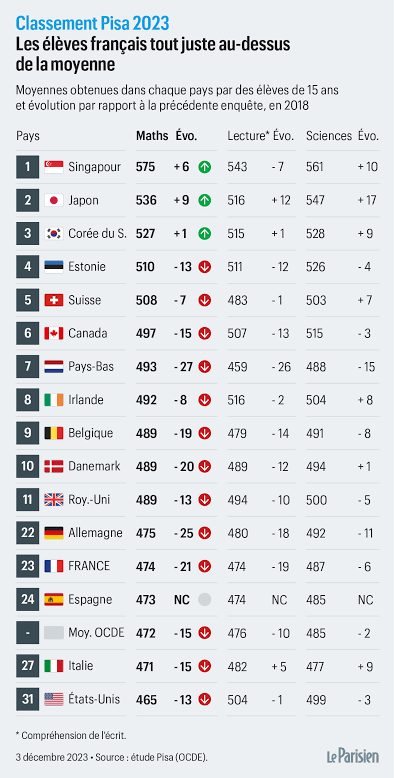
Conversely, Western Europe is experiencing a continuous erosion of its educational capital, irrefutably confirmed by the OECD’s 2022 PISA rankings.
- French collapse: Massive loss of 37 points in mathematics between 2003 (511 pts) and 2022 (474 pts).
- Incapacity threshold: 29% of 15-year-old French students no longer reach Level 2 (the absolute minimum foundation).
- European contagion: Germany collapsed by 25 points in mathematics since 2018 (dropping to 475 pts).
- Asian supremacy: Singapore (575 pts) and Japan (536 pts) dominate the rankings, validating a protective and demanding educational model.
3. Skills Asymmetry: The STEM Shortage
This disconnect translates directly into a shortage of graduates in engineering and hard sciences (STEM), the main driver of innovation (R&D).
- Asian hegemony: Asia produces about 76% of global STEM graduates. China alone trains over 3.5 million STEM profiles per year.
- European atrophy: Europe accounts for only 8% of the global total. France generates about 220,000 STEM graduates per year, and Germany about 216,000.
4. The Origins: Algorithmic Overexposure
The inability of the European school system to produce engineers is intrinsically linked to an exogenous modification of young people’s mental environment.
The architecture of applications running on continuous scrolling (infinite scroll) asymmetrically exploits the dopaminergic system of developing brains. This uninterrupted capture severely interferes with the executive functions of the prefrontal cortex, destroying the sustained attention capacity required for mathematical abstraction.
- Estimated reliability of neuro-clinical correlations: 80% (Strong consensus on the alteration of attentional capacities by overexposure, although debates persist in developmental psychology regarding the strict separation of direct causality and socio-economic factors).
5. Calculation of the Societal Rupture Threshold (Horizon 2060)
If the current dynamic is not halted, Europe will reach a rupture threshold where it will no longer possess the critical mass of skills required to maintain its advanced infrastructures (nuclear, telecommunications, smart power grids).
Trajectory modeling:
- Decay rate ($V_d$): $37 \text{ pts} / 19 \text{ years} \approx 1.947 \text{ points/year}$.
- Rupture threshold ($S_r$): Set at a PISA score of 400 points (Level 1, absence of basic formal logical application for the majority of the cohort).
- Critical gap from the 2022 measurement: $474 – 400 = 74 \text{ points}$.
- Horizon before rupture ($H_r$): $\frac{74}{1.947} \approx 37.99 \text{ years}$.
- Tipping year: 2060 (2022 + 38 years).
- Estimated reliability of the mathematical modeling: 65% (Purely linear projection model. It does not integrate potential exponential acceleration effects linked to the use of generative AIs in learning practices, nor the potential slowdowns due to the recent laws of 2025).
6. The European Legislative Response
Faced with the explicit warnings of the Draghi report (2024) and the Public Treasury (2025), the initial response was endogenous (ability grouping in France) and bureaucratic (European STEM plan).
It was only in 2025-2026 that France initiated a genuine normative shift:
- Total ban on screens in nurseries and early childhood care centers (July 2025).
- Senate adoption of a strict digital age of majority (late 2025) aimed at protecting adolescents.
However, these texts still clash with the immense technical challenges of enforcement on individual devices, remaining far from the mastery of the Chinese state apparatus. Europe’s technological survival will require the short-term establishment of an authentic cognitive ecology integrated directly into hardware operating systems.
2060 Rupture Threshold
Strategic Divergence and Cognitive Disconnect: Europe vs China
— Minutes to Midnight
Midnight = Capacity Collapse (PISA Score < 400)
Estimated Remaining Time
Strategic Updates (2024-2026)
- 2023-2025 Assessments: TIMSS 2023 data confirms stagnation of French math levels below the European average. The December 2025 Treasury report officially warns of the macroeconomic impact of cognitive decline on productivity.
- Reinforced Chinese Coercion (2024): The CAC imposes a mandatory software « minor mode. » Strict digital curfew (10:00 PM – 6:00 AM) and drastic daily quotas (40 min for <8 yrs, 2h for 16-18 yrs).
- European Response (2025): Adoption of the post-Draghi strategic plan for STEM education, aiming to halt the engineer shortage through incentive logics.
- French Legislation (2025-2026): Total ban on screens in daycares and with childminders (July 2025). Ongoing review of digital majority for social media access.