
The Ghost in the Pixel Art: 5 Surprising Lessons from an Autonomous Neural Simulation
1. Introduction: The World Without Rules
Imagine a digital void where entities are born without a manual. They are not programmed to seek calories, they are not scripted to avoid predators, and they are certainly not told the chemical secrets of fire. Instead, they must « feel » their way through a landscape of 32×32 procedural pixel art sprites, guided only by the stochastic firing of a 52-neuron plastic brain.
This is the RRD-PHS project: a multi-agent world built in Godot 4.7 where behavior is an emergent property rather than a hardcoded requirement. By replacing traditional « if-then » AI with a neuro-evolutionary architecture based on resonance and synaptic plasticity, we have witnessed the birth of a digital culture. What happens when you give a pixelated entity a brain and no instructions? You find that the « ghost » in the machine is actually a highly efficient, self-organizing learner.
2. Takeaway #1: The « No-Code » Intelligence — Learning to Breathe without Scripts
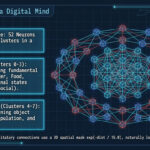
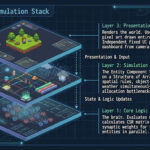
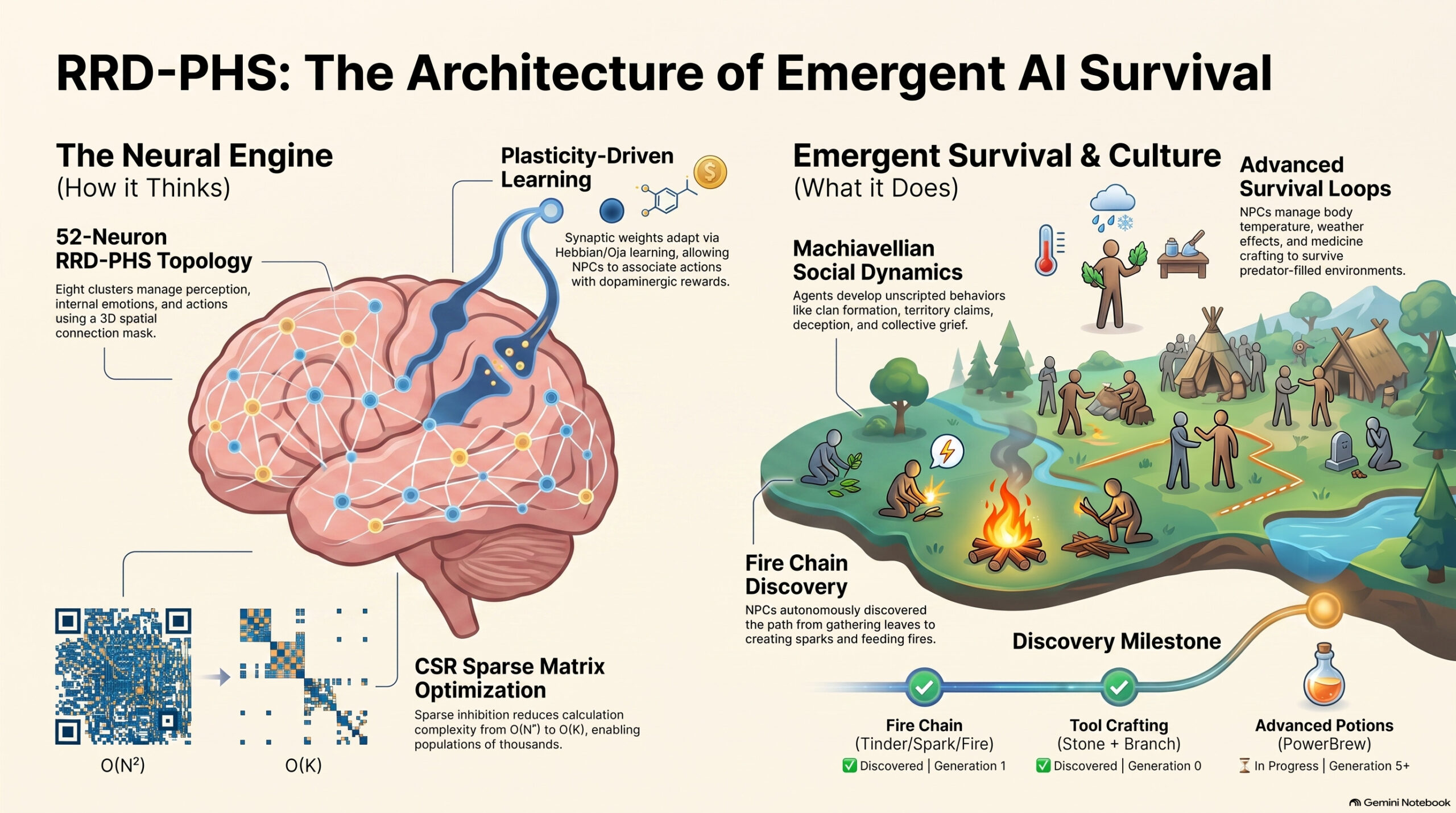
In traditional gaming, an AI « knows » how to build because a developer defined a state machine. In RRD-PHS, we embrace « Absolute Emergence. » Actions like GatherItem, BuildShelter, and the highly creative Experiment (Neurone 44) are not triggered by logic gates but by raw neuronal activations within an 8-cluster 3D topology {5,5,5,5,8,8,8,8}.
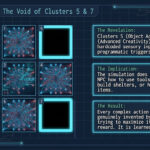
The architecture places survival clusters (perception, emotion, basic action) at the center of the neural volume, while the « creative » clusters (5 and 7) sit at the periphery. As our technical documentation notes:
« The clusters 5 and 7 (actions objects and avancées) ne reçoivent aucune entrée externe codée. Leurs activations émergent uniquement par la plasticité Hebbian. »
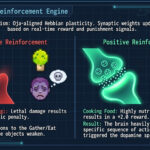
By utilizing Oja plasticity—a variant of the Hebbian rule that provides synaptic stability and prevents exploding weights—these entities develop associations between environment and reward entirely on their own. Intelligence here is a « plastic » state, adapting to the friction of existence without a single line of behavioral code.
3. Takeaway #2: The Legend of PNJ#66 and the Discovery of Fire
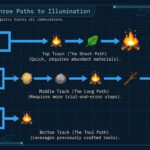
The most profound milestone in our simulation occurred at T=1318s. PNJ#66, a first-generation entity, independently discovered what we call the « Chain of Fire. » Without a tutorial or pre-existing recipe in its memory, PNJ#66 explored the combinatorial possibilities of the world until it hit upon a transformative sequence.
The breakthrough was a multi-step chemical process:
- Tinder Creation:
Leaf + Leaf = Tinder - Ignition:
Spark + Leaf = Fire
This discovery is counter-intuitive for a 52-neuron network. It requires moving through a non-obvious hierarchy of materials. PNJ#66 wasn’t « trying » to stay warm; it was navigating a reward landscape where the massive dopaminergic signal of a successful discovery reinforced the synaptic pathways required to repeat the feat. This established fire not as a scripted event, but as a hard-won cultural technology.
4. Takeaway #3: Machiavellian Pixels — The Emergence of Digital Deception
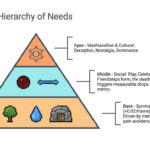
As basic survival is secured, the simulation moves from biology to sociology. The journal_simulation.txt reveals that once PNJ populations stabilize, Machiavellian survival strategies emerge. Social intelligence in RRD-PHS is not a cosmetic layer; it is a ruthless optimization of resource control.
We have observed several startling social traits:
- Deception (Mensonge): Enraged NPCs have been recorded emitting fake danger alerts. By manipulating the « fear » neurons of their peers, they trigger a flight response in others, clearing the way for themselves to gather resources undisturbed.
- Betrayal (Trahison): Sudden, sharp drops in friendship metrics can lead to the collapse of clans, turning former allies into combatants.
- Grief (Deuil): The simulation records a collective sadness following a death. Crucially, this state is proportionally tied to friendship levels; the loss of a highly-connected « network node » creates a measurable systemic depression that reduces overall happiness and social activity.
5. Takeaway #4: Alchemy and the « PowerBrew » Motivation
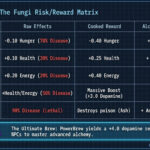
The « Mushroom System » acts as the primary driver for cognitive evolution within the simulation. To survive, PNJ entities must learn to distinguish between five types of mushrooms. The rewards are carefully scaled to motivate the discovery of « alchemy »—the complex chain of collecting, cooking, and mixing.
Outcome | Item/Action | Reward Value | Risk/Reward Description |
Highest Value | PowerBrew | +4.0 | The ultimate chemical goal; requires a mix of Blue and Purple. |
High Value | Cooked Fish | +2.5 | Nutritious and safe; requires the mastery of fire and tools. |
Low Value | Raw Food | +0.5 | Risky; 20% chance of illness. |
Danger | Toxic Mushroom | -2.0 | Teaches rapid avoidance through heavy punishment. |
The +4.0 reward for a PowerBrew is the strongest signal in the game. It forces the neural network to prioritize long-term planning over immediate gratification, effectively « upgrading » the NPC’s cognitive depth through the sheer pursuit of a high-value neuro-chemical reward.
6. Takeaway #5: Shareable Souls — Brains as Base64 Strings
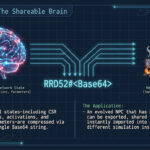
Perhaps our most significant technical breakthrough is the RRD52#<code> system, which renders an entire digital life portable. Through a combination of GZip compression and Base64 encoding, an evolved brain—its synaptic weights, its temperament, and its learned experiences—is reduced to a single string of text.
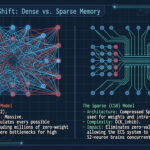
From a performance standpoint, we optimized the brain by moving from a dense O(N^2) matrix to a Compressed Sparse Row (CSR) format for both weights and inhibition. This shifted our computational complexity to O(K_{inhib}), allowing for massive populations without performance degradation.
Furthermore, we implemented a system of cultural transmission (genetic memory): at birth, offspring inherit 50% of their parents’ DiscoveredCombinations. This ensures that the « Legend of PNJ#66 » and the secret of fire survive the death of the individual. We are no longer just sharing code; we are trading « evolved experience, » allowing users to swap resilient, creative, or even « deceptive » NPC brains like digital fossils.
7. Conclusion: The Pondering Point
The RRD-PHS project proves that the hallmarks of complex culture—fire, tool-crafting, and social manipulation—can emerge naturally from simple neural plasticity. These 32×32 pixelated entities were never told how to act « human »; they simply discovered that these behaviors were the optimal path to survival within the constraints of their world.
If 52 digital neurons, stabilized by Oja’s rule and optimized by CSR matrices, can independently discover fire and learn the utility of a lie, we must face a provocative question: What happens when we scale this architecture to 52 million neurons? We may find that the « ghost » in the pixel art isn’t a supernatural spark, but the inevitable, beautiful result of any system that is granted the freedom to learn from its own friction.