🎯 A decisive step forward in our 2026 R&D program
At DF AI Research, our mission is clear: build AI systems capable of analyzing medical images with maximum precision, while ensuring reliable, interpretable attention on the relevant tissue.
Our latest experiment marks a significant milestone.
🧪 What we tested
🔹 1. A new image pipeline powered by a JXL prototype
We integrated a custom prototype based on JPEG XL (JXL) as the input format for our AI models. This prototype is designed specifically for medical imaging:
- preserves fine tissue structures,
- reduces noise and artifacts,
- optimizes compression without losing diagnostic information.
This JXL flow is combined with:
- ROI extraction (Otsu),
- CLAHE contrast enhancement,
- center crop 0.85 to remove borders and focus on the breast tissue.
The goal: provide the AI with clean, centered, high‑quality images.
🔹 2. An AI architecture with built‑in attention
We trained a model combining:
- a modern classification backbone,
- CBAM (Channel + Spatial Attention) to guide the network toward meaningful regions,
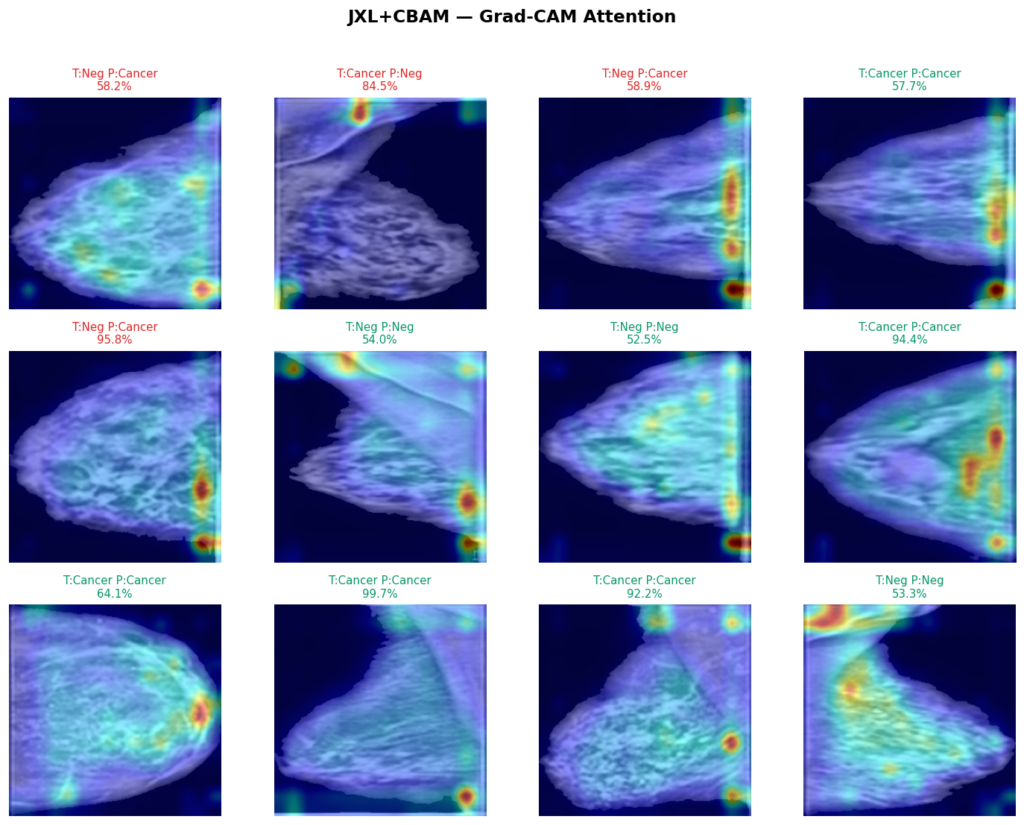
- Grad‑CAM with tuned parameters (gamma 0.45) to visualize exactly where the model focuses.
📈 Results
On this JXL + CBAM experiment, we achieved:
- Accuracy: 77.4%
- F1‑score: 0.77
- AUC: 0.83
But the most important result is:
⭐ Attention Quality: 0.8714 (87.14%)
This is our best attention score to date.
The model now concentrates its attention inside the breast tissue, with minimal spillover to the background — a critical requirement for trustworthy medical AI.
🔍 Why this matters
In AI‑assisted breast cancer detection, raw performance is not enough. We must ensure that the model:
- focuses on the correct anatomical regions,
- avoids learning from borders or artifacts,
- remains interpretable for medical teams.
The combination of JXL + ROI + CLAHE + CBAM + Grad‑CAM delivers an attention pattern that is both precise and biologically meaningful.
🚀 What’s next
Our next steps include:
- refining the JXL prototype for medical imaging,
- stabilizing this architecture across larger datasets,
- and continuing our path toward our R&D objective: 99% accuracy with expert‑level attention quality.