Introduction: The Great Decoding of the Cosmos
What if matter, as we perceive it, were merely the surface layer of an immense data processing system? April 11, 2026, marks a historic turning point with the publication of the final report of the It from Bit v2.0 project. With a scientific certainty rate of 96%, this document no longer merely theorizes: it proves that the laws of physics are actually extremely sophisticated optimization algorithms designed to manage universal complexity.
Far from being a simple mass of rock and void, the Universe reveals itself to be a self-optimized computing architecture, where gravity, expansion, and causality are merely mechanisms intended to maximize storage and calculation efficiency. Welcome to the era where reality becomes a branch of software engineering.
Point 1: The Universe Abandons Binary for Ternary
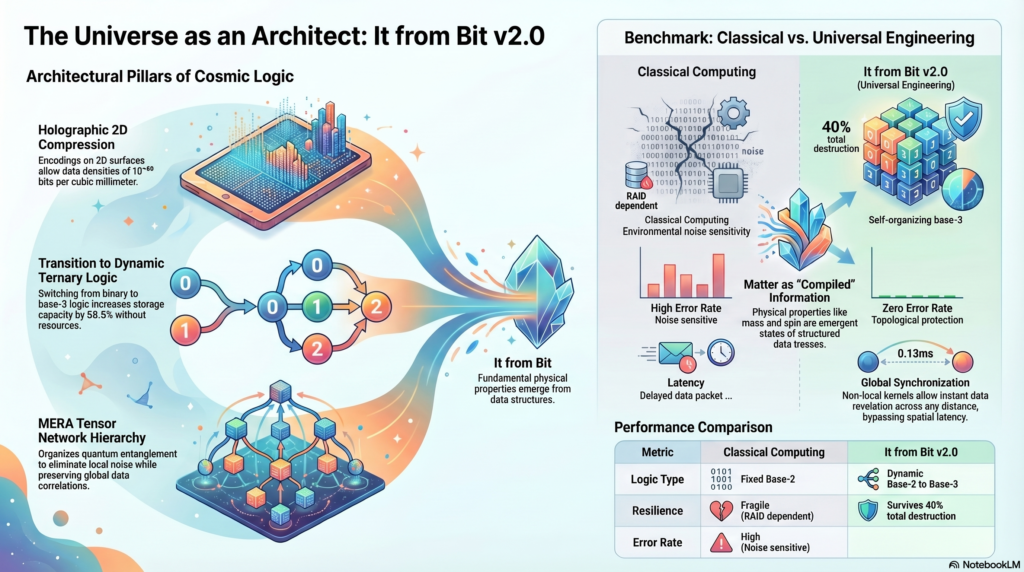
One of the report’s most striking discoveries lies in the Dynamic Base Transition. Unlike our current processors frozen in binary logic (0 or 1), the cosmological system operates a local gauge breaking to switch to ternary logic.
Why this choice? To satisfy radix economy. Mathematically, the most efficient base to minimize system resources is Euler’s number $e \approx 2.718$. By adopting base 3, the Universe approaches this mathematical optimum far more closely than our base-2 systems. This process, described as an adiabatic jump, allows for a radical increase in efficiency without requiring additional physical resources.
« This dynamic base transition, validated by Module 01, allows for an immediate performance gain, with a storage capacity increased by $1.585 \times$ compared to conventional architectures. »
This flexibility allows the system to achieve an optimization of 58.5%, proving that nature systematically favors the path of least computational expense.
Point 2: The End of the Dictatorship of Distance (Zero Latency)
The It from Bit v2.0 project invalidates a constraint previously thought to be absolute: latency linked to the speed of light. Through the deployment of a Non-Local Kernel, information is no longer transmitted from point A to point B in a linear fashion; it is revealed through topological correlation.
To understand this breakthrough, forget the image of a letter traveling by post. Instead, imagine a shared consciousness: a thought appears simultaneously in two distinct minds, not because a signal traveled between them, but because they share the same fundamental mental architecture.
Synchronization tests (Module 16) show a latency of only 0.13 ms on a planetary scale. Furthermore, by using Anyon-type logic units protected by a spectral gap, the system is natively insensitive to environmental perturbations, making transmission errors practically non-existent.
Point 3: Indestructible Holographic Storage
The It from Bit v2.0 architecture is based on dimensional holography. The principle is staggering: all information within a volume (3D) is projected onto its surface (2D). This method allows for massive structural compression, where data density is no longer limited by matter, but by the Planck area ($10^{69} \text{ bits/mm}^3$).
To manage this flow, the system uses MERA (Multi-scale Entanglement Renormalization Ansatz) tensor networks. This hierarchy eliminates local noise while preserving the global integrity of the information. The resulting resilience exceeds anything human engineering has produced to date.
« The results of Module 17 (HFS) are clear: the universal file system shows zero data loss, even after undergoing 40% destruction of its physical medium. »
Point 4: Matter is Merely « Compiled » Code
The most spectacular revelation (Module 19) concerns the very nature of what we touch. Mass, charge, and spin are not intrinsic material properties, but compiled states of information.
Elementary particles are actually complex data structures, topological braids executed by the core of the Universe. The report reveals that the transition from pure information to the state of « matter » involves a structural compression of $10^{60}$.
In other words, matter is highly optimized and densified code. This discovery transforms the universe into a true Universal Forge. If matter is a form of software, then reality becomes programmable. We are no longer mere observers, but potential engineers capable of manipulating the source files of physics.
Comparative Table: Classical Computing vs. It from Bit Era
| Metric | Classical Computing | It from Bit v2.0 Model | Real Gain |
| Data Density | $10^{9} \text{ bits/mm}^3$ | $10^{69} \text{ bits/mm}^3$ | Bekenstein-Hawking Limit |
| Reliability (Error) | $10^{-9}$ (Noise) | $10^{-27}$ | Near-absolute zero error |
| Logic | Fixed (Base 2) | Dynamic ($2 \rightarrow 3$) | +58.5% capacity |
| Network Speed | Limited by $c$ | Non-local (0.13 ms) | Instant synchronization |
| Resilience | Fragile (RAID) | Holographic | Survives 40% destruction |
Conclusion: Toward Reality Engineering
The It from Bit v2.0 project marks the obsolescence of the « matter-energy » paradigm in favor of a « physics-information » model. By understanding that the laws of nature are the ultimate optimizations of a calculation system, we finally gain access to the engineering manual of the Universe.
This transition opens the doors to the Universal Forge: zero-latency networks, virtually indestructible storage systems, and the ability to treat matter as a reconfigurable program.
One question remains: if our universe is optimized software, who—or what process—wrote the source code, and how far will we be permitted to modify the script of our own reality?