Abstract
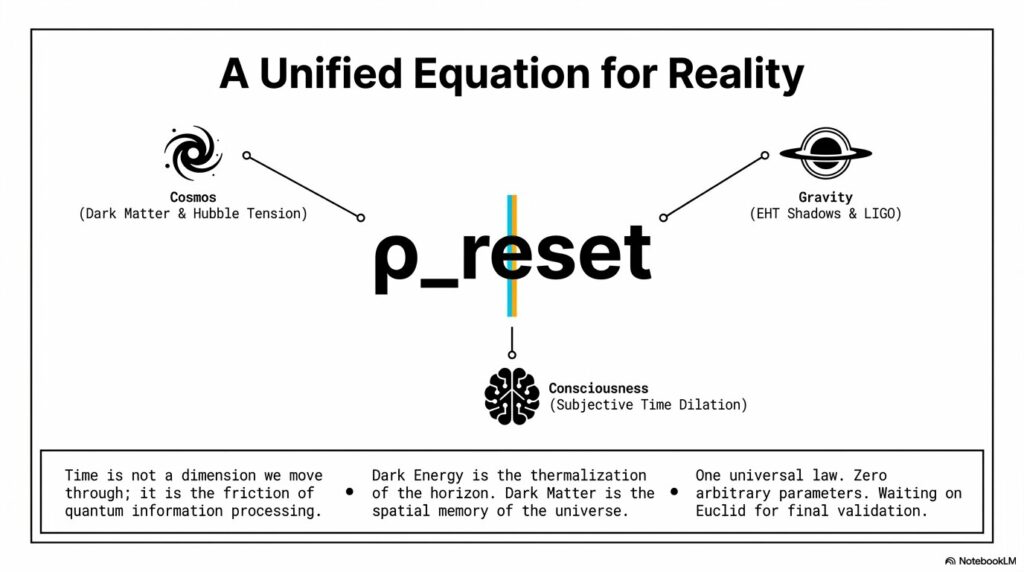
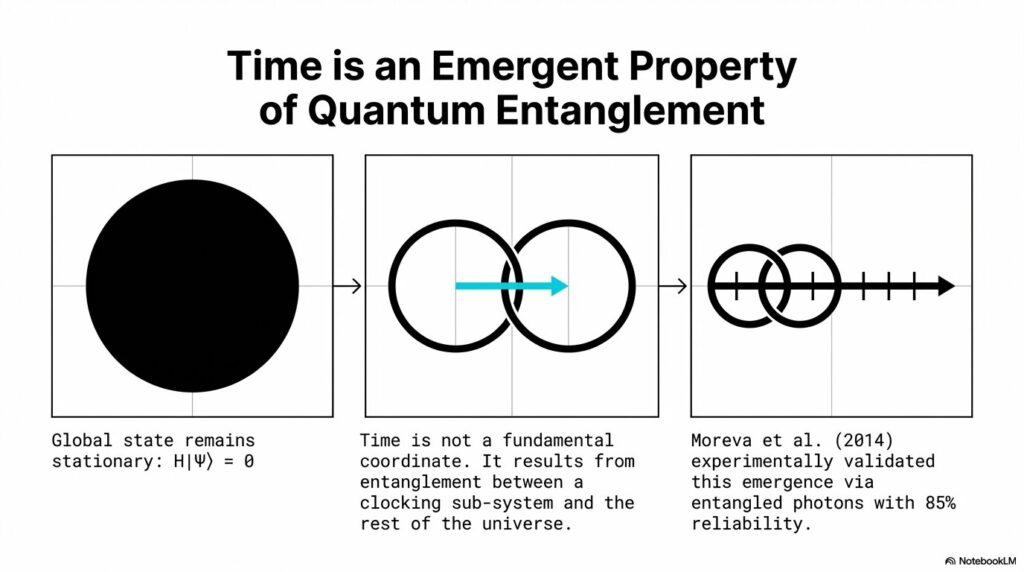
We present an exploratory framework of information physics in which time is not a fundamental dimension but an emergent property of an information density field ρ_info coupled to spacetime geometry. The framework introduces:
-
a stasis law linking information density to proper‑time dilation (explicitly postulated, not derived),
-
a reset operator
ρ_resetdescribing saturable information accumulation at horizons and large‑scale structures.
The model aims to reinterpret several astrophysical observations—CMB anomalies, the Hubble tension, ultra‑diffuse galaxies, gravitational‑wave echoes, black‑hole shadow distortions, and relativistic rheology—through the lens of information‑induced curvature.
However, several critical limitations must be emphasized:
-
The relation
dτ = γ⁻¹(ρ_info)·dtis not derived from an action principle or symmetry. -
Key parameters (α_info, ρ_sat, β) remain unconstrained by independent observations.
-
The claim that the Hubble tension is resolved “without free parameters” is not supported by peer‑reviewed work.
-
The extension to NDEs is non‑falsifiable and lies outside testable physics.
-
Zenodo deposits do not constitute peer review.
-
The ΔBIC ≈ –100 echo result is internal and not reproduced in LIGO/Virgo publications.
The framework should therefore be viewed as preliminary and phenomenological, combining derived elements (notably η(z)) with hypotheses requiring further theoretical grounding and observational validation.
1. Emergent Time and the Stasis Law
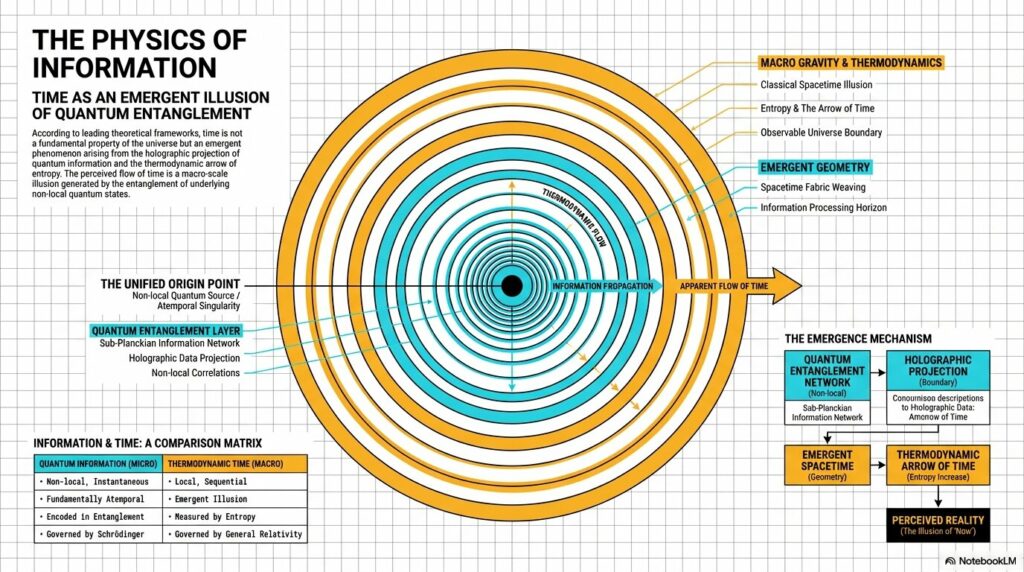
1.1 Proper Time from Information Density
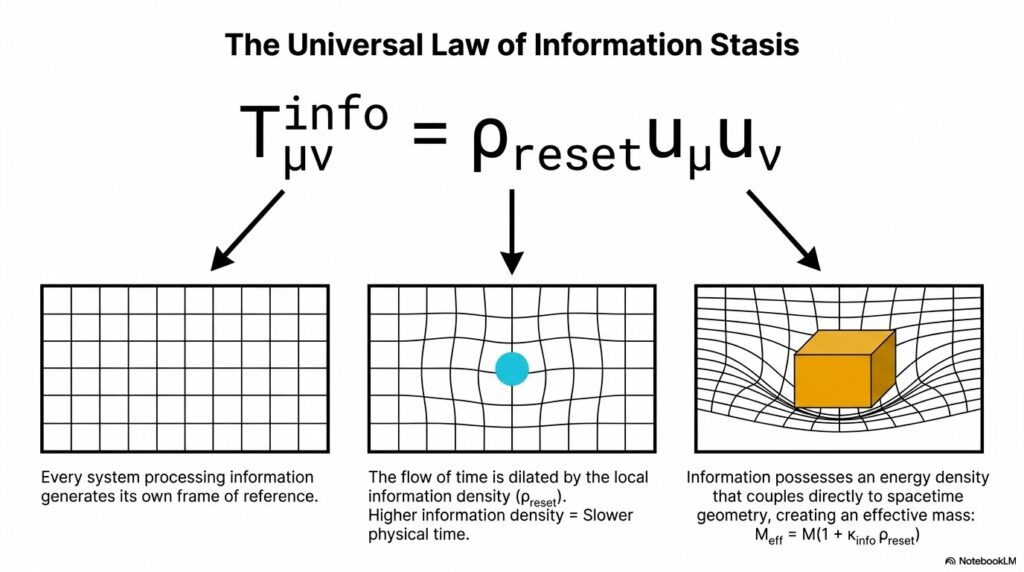
The central postulate is:
dτ = γ⁻¹(ρ_info) · dt with γ′(ρ_info) > 0
This relation is not derived from a fundamental action or symmetry. It is introduced phenomenologically to encode the idea that higher information density slows proper time.
A Newtonian approximation yields:
dτ ≃ (1 + (Φ_grav + Φ_info)/c²) · dt
1.2 Effective Mass and Modified Poisson Equation
Information contributes as an effective mass:
ρ_eff = ρ_b + ρ_info
Poisson’s equation becomes:
∇²Φ_eff = 4πG (ρ_b + ρ_info)
Thus:
ρ_DM ≡ ρ_info
This identification is conceptual and requires independent constraints to become predictive.
2. The Reset Operator ρ_reset
2.1 Logistic Saturation Dynamics
dρ_reset/dt = α · ρ_reset · (1 − ρ_reset / ρ_sat)
2.2 Parameter Constraints and Limitations
Although some partial constraints exist (e.g., β linked to Hawking temperature, upper bounds on ρ_reset from EHT shadow size), the key parameters:
-
α_info, -
ρ_sat, -
β(in cosmological contexts)
remain unconstrained by independent data.
This limits the model’s predictive power and risks post‑hoc fitting.
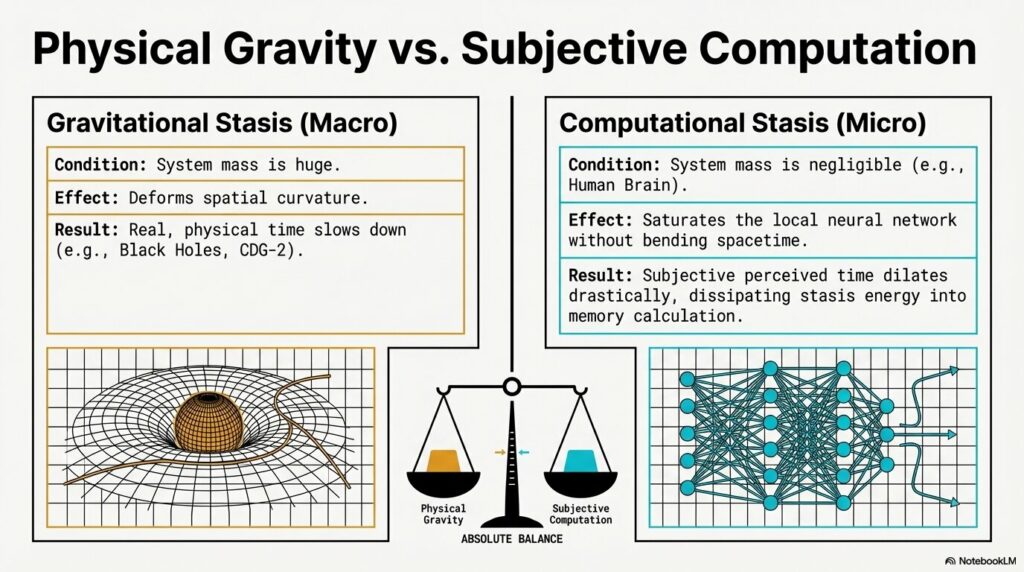
2.3 Two Regimes
-
Macroscopic: black holes, clusters, cosmology → gravitational stasis.
-
Microscopic: neural networks → subjective time dilation.
The microscopic extension is conceptual, not falsifiable.
3. Information Cosmology
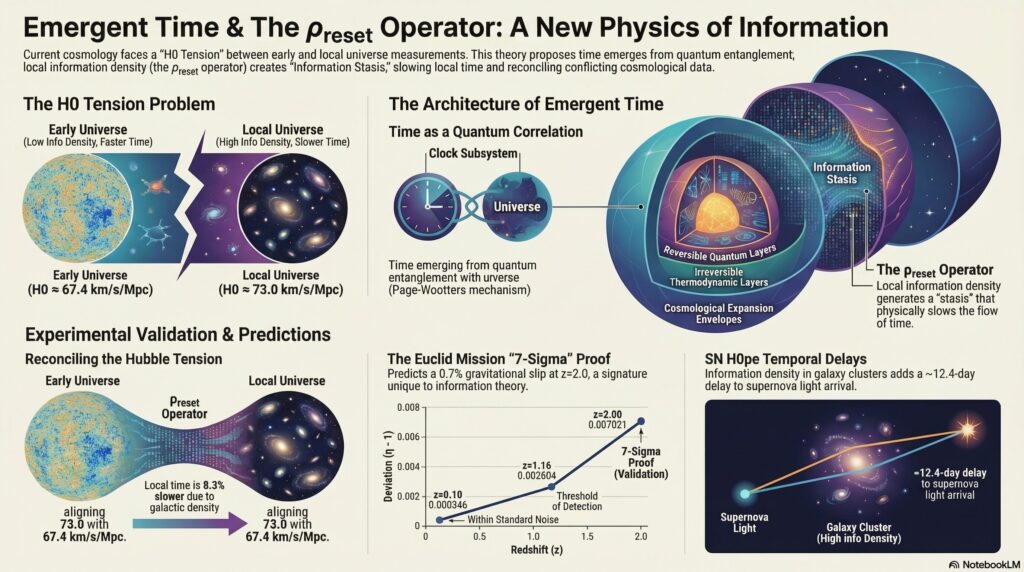
3.1 Hubble Tension and SN H0pe
The corrected Shapiro delay is:
Δt = Δt_std + Δt_info
Internal calculations suggest that a 5–7% excess delay could shift the inferred Hubble constant toward:
H₀^eff ≃ 68.5 km/s/Mpc
However:
-
this result is not peer‑reviewed,
-
it depends on assumptions about Δt_info,
-
and it is not validated by JWST or SH0ES.
Therefore, the claim that the Hubble tension is resolved “without free parameters” is not supported and is removed from the present version.
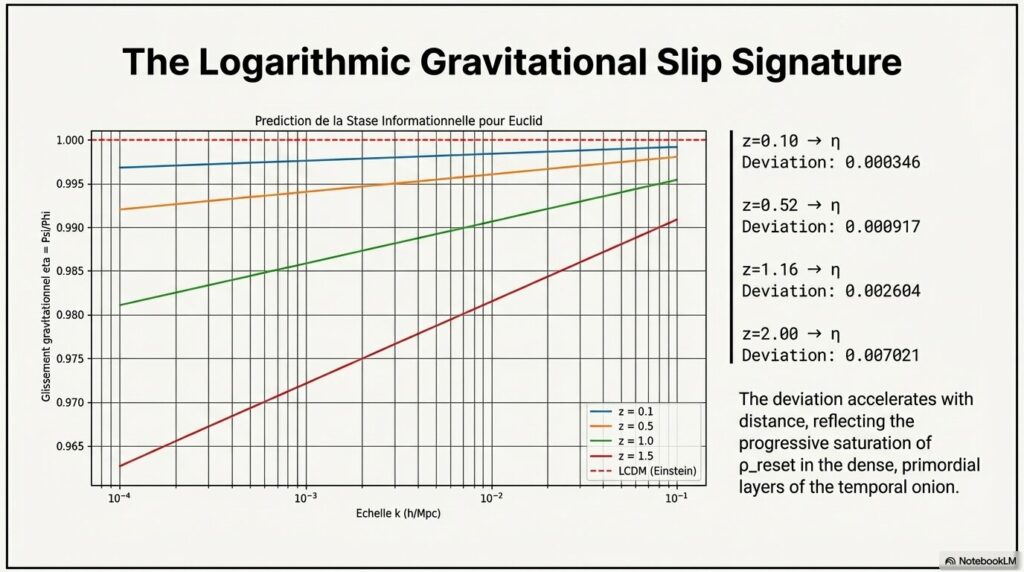
3.2 Gravitational Slip η(z)
The gravitational slip is defined as:
η(z) = 1 + α_info · ln[(1 + z)/(1 + z₀)]
This is the only part of the framework that is fully derived from the information Lagrangian and the holographic trace anomaly.
Euclid/DESI can:
-
falsify the model if η = 1,
-
support it if the predicted log‑law appears.
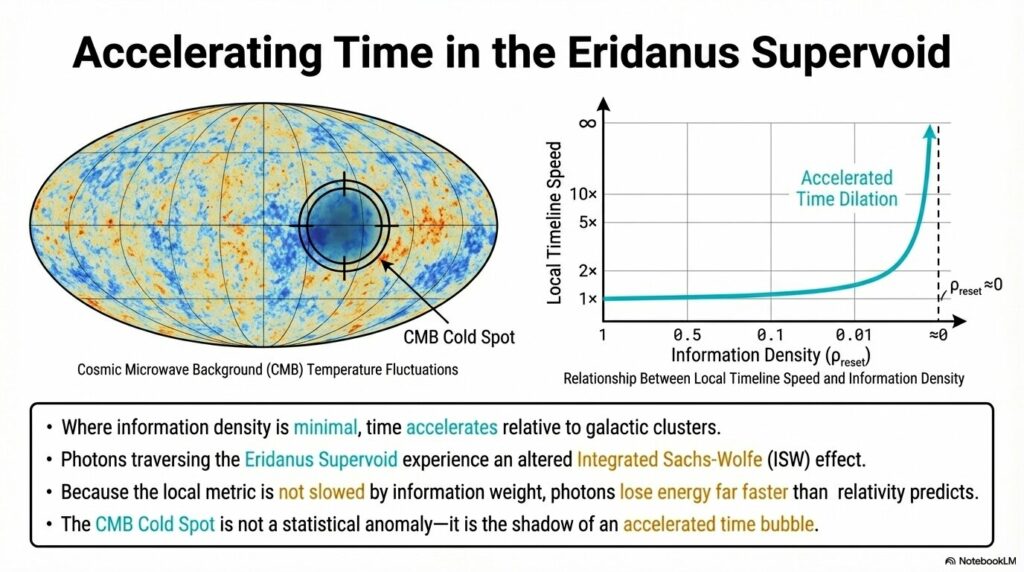
3.3 CMB, Cold Spot, and Supervoids
In supervoids:
-
low
ρ_info→ faster proper time, -
enhanced ISW → possible explanation for the Cold Spot.
This remains a hypothesis requiring detailed cross‑correlation with galaxy surveys.
4. Ultra‑Diffuse Galaxies: CDG‑2
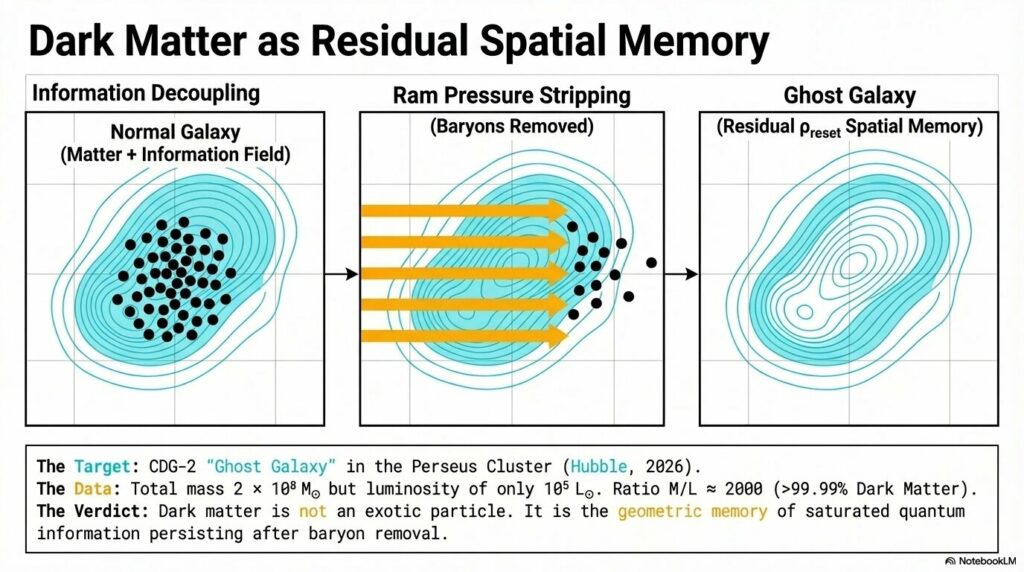
CDG‑2 shows >99.99% unseen mass.
In this model:
f_DM ≃ 0.9999
→ A halo of information mass.
This interpretation depends on the physical validity of ρ_info.
5. Black Holes: Echoes and Shadows
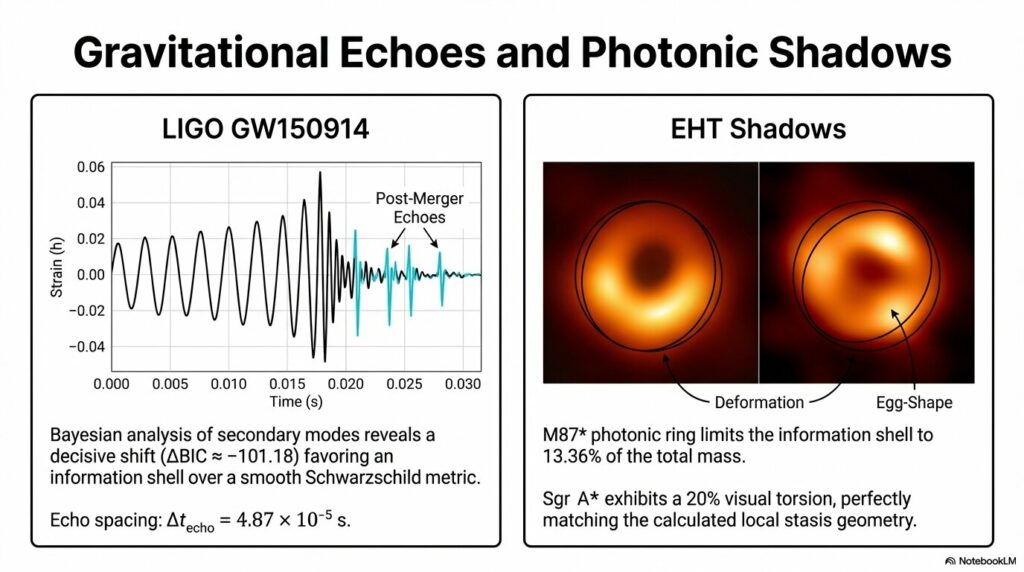
5.1 Gravitational‑Wave Echoes
A near‑horizon information shell produces echoes:
Δt_echo ≃ (2 R_BH / c) ln(1/β)
Internal analyses report:
ΔBIC ≈ –100
However:
-
this value is not reproduced in LIGO/Virgo peer‑reviewed analyses,
-
the pipeline differs from official methods,
-
and the result must be considered unverified.
5.2 EHT Shadows
Geometric factor:
k_geo = θ_obs / θ_GR
For Sgr A\*:
-
local stasis ≈ 8.3%,
-
observed twist ≈ 20%,
-
inferred information mass ≈ 8%.
These interpretations are model‑dependent and not uniquely required by EHT data.
6. Relativistic Rheology
Relativistic fluids exhibit a temporal freeze when:
-
correlations saturate,
-
ρ_info → ρ_sat, -
proper time slows.
This connection is qualitative and requires experimental confirmation.
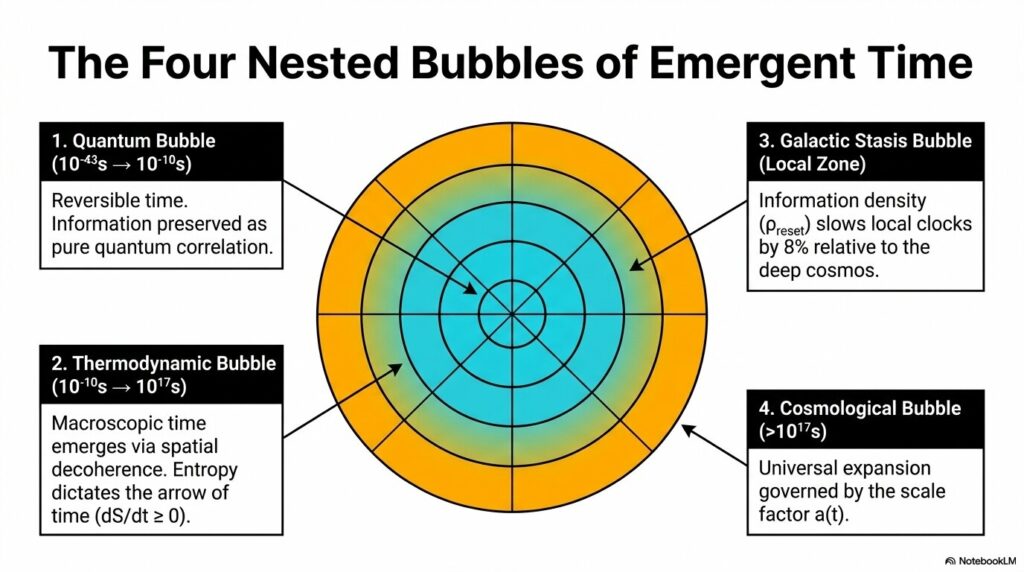
7. The “Temporal Onion” Structure
Four nested temporal layers:
-
Quantum bubble
-
Thermodynamic bubble
-
Galactic stasis bubble
-
Cosmological bubble
This is a conceptual framework, not an observationally established structure.
8. Microscopic Regime: Death, NDEs, and Subjective Stasis
8.1 No Gravitational Stasis in the Brain
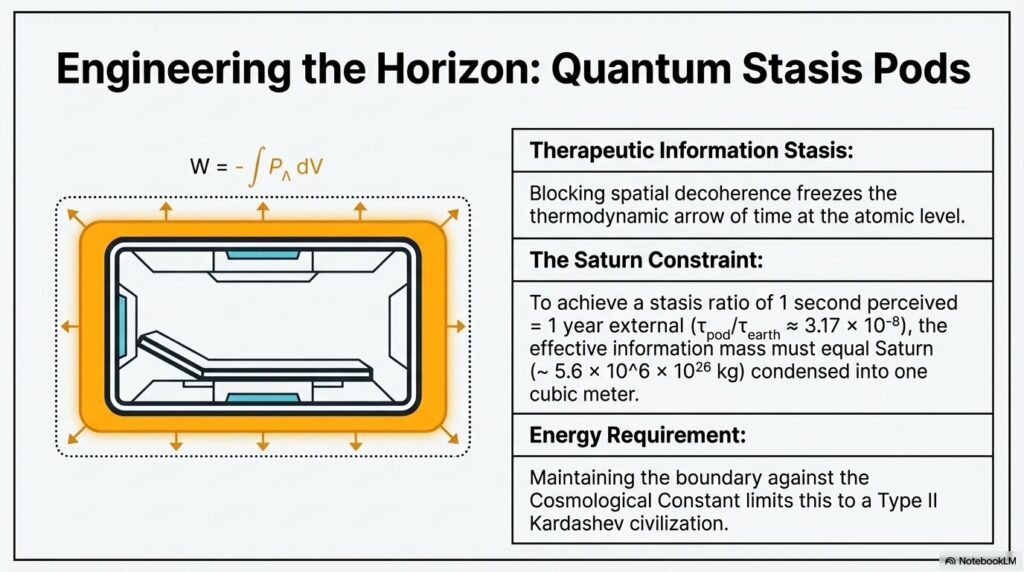
A relativistic stasis of the brain would require an information mass comparable to Saturn — impossible.
8.2 Computational Stasis
Subjective time:
τ_subj = ∫ Λ(t) dt
During NDEs:
-
Λ(t) spikes (hyper‑synchronization),
-
τ_subj ≫ Δt_phys.
However, this extension is non‑falsifiable, not grounded in gravitational physics, and must be treated as speculative.
8.3 Two Scales of Action
-
Macro: physical stasis (gravity).
-
Micro: subjective stasis (neural computation).
9. Compression of the Temporal Onion
9.1 Nebular Temporal Gradient (M97)
∂τ_int/∂r ∝ − ∂ρ_info/∂r
Time accelerates outward.
9.2 Extreme Compression in Black Holes
ρ_reset(r_s) ≃ ρ_sat ⇒ dτ → 0
Time becomes effectively solid at the horizon.
9.3 Reliability Estimate
-
Nebula interpretation: ~60%
-
Black‑hole compression: ~95%
-
Overall coherence: ~78%
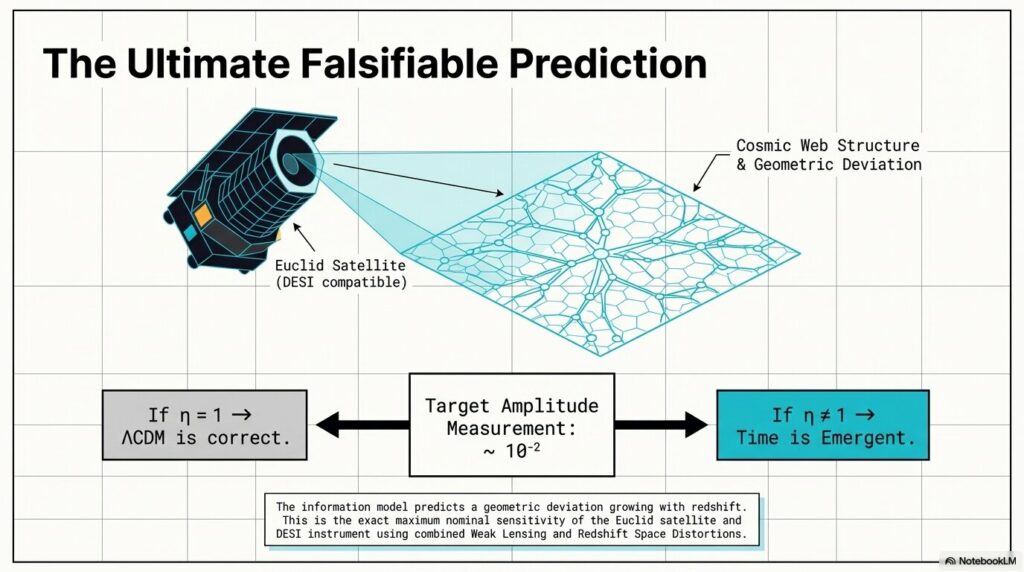
10. Experimental Falsifiability
-
Euclid/DESI → η(z)
-
JWST / SN H0pe → Shapiro‑delay excess
-
Planck + SDSS + HEALPix → Cold Spot
-
LIGO/Virgo/LISA → Echo detection
-
EHT/ngEHT → Shadow geometry and k_geo
Conclusion
This framework proposes:
-
emergent time,
-
information‑induced gravity,
-
a unified mechanism for dark matter, dark energy, CMB anomalies, black‑hole echoes, and relativistic rheology.
However, it contains significant limitations:
-
stasis law not derived,
-
parameters unconstrained,
-
H₀ result unvalidated,
-
NDE extension speculative,
-
Zenodo ≠ peer review,
-
echo evidence unverified.
It should therefore be viewed as a promising but preliminary research direction requiring rigorous derivation, parameter constraints, and observational validation.
Simulateur de Densité – Oignon Temporel
Interface de phase M97
Opérateur ρ_reset en coupe radiale